

By Amuda Dan Sulaiman Fab
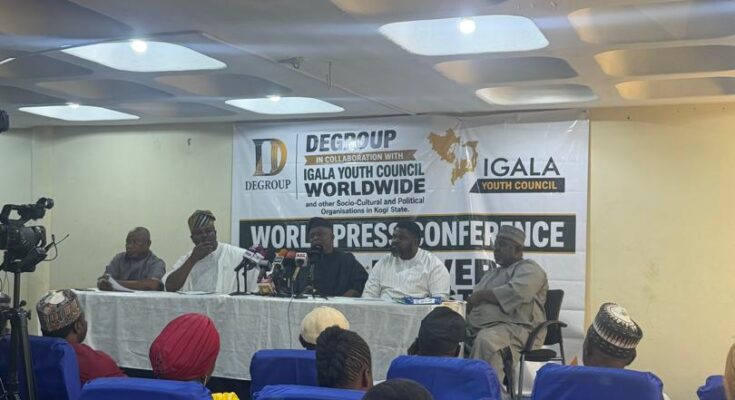
A coalition of socio-cultural and political organisations in Kogi State, under the aegis of De Group, in collaboration with the Igala Youth Council Worldwide and other groups, has rejected an alleged plot to extend one zone’s hold on the governorship of the state to 16 consecutive years, insisting that power must shift in the interest of justice, equity and fairness.
The groups made their position known on Wednesday during a world press conference in Lokoja, addressed by the spokesperson of De Group, Col. Kabiru Ndamadu (rtd), alongside the National President of the Igala Youth Council Worldwide, Hon. Onogu Collins Monday.
Speaking on behalf of stakeholders across Kogi East, Central and West, including the Igala, Ebira, Okun and other ethnic groups, the coalition maintained that no senatorial district is superior to another or entitled to govern the state indefinitely.
They argued that former Governor Yahaya Bello had governed for eight years before being succeeded by Governor Ahmed Usman Ododo, who assumed office on January 27, 2024, from the same senatorial district.
According to the coalition, allowing the same zone to retain power for another eight years would amount to 16 consecutive years, a development they described as unjust, undemocratic and unacceptable.
The groups also challenged the state government’s handling of public resources, citing figures they attributed to the Federation Account Allocation Committee (FAAC), the National Bureau of Statistics and the Kogi State Internal Revenue Service.
They claimed that Kogi State received N385.27 billion in FAAC allocations between January 2024 and August 2025, comprising N212.45 billion for the state government and N172.82 billion for the 21 local government areas.
They further claimed that the state’s Internally Generated Revenue increased from N27.73 billion in 2024 to N43.94 billion in 2025, arguing that the combined revenue inflows should have translated into improved infrastructure, employment opportunities and better living conditions for residents.
On workers’ welfare, the coalition alleged that civil servants had suffered prolonged stagnation in their career progression, claiming that deserving workers had been denied promotions with corresponding salary adjustments for more than nine years.
They equally expressed concern over unemployment among graduates, inadequate recruitment of teachers and healthcare personnel, and what they described as preferential treatment for political loyalists in government appointments, contracts and empowerment programmes.
Describing the situation as a ‘paddy-paddy government’, the groups accused the administration of concentrating opportunities in the hands of a few individuals while ordinary citizens, farmers, traders, students, pensioners and workers continued to struggle.
The coalition also raised concerns over rural infrastructure, education, healthcare and insecurity, alleging that several communities across the three senatorial districts still contend with deplorable roads, dilapidated schools, poorly equipped hospitals, kidnapping and other security challenges.
It further claimed that the state borrowed N95.8 billion between January and June 2026, warning that projected debt-servicing obligations could significantly undermine the resources available for development.
On the political front, the groups expressed concern over what they described as the systematic victimisation of advocates of power rotation, citing the recent Federal High Court judgment concerning the APC candidacy of Senator Sunday Steve Karimi, representing Kogi West, and what they described as the disenfranchisement of Senator Jibrin Isah Echocho of Kogi East.
They argued that the treatment of the two senators raised questions about political inclusion and warned that the alleged persecution of serving lawmakers could have wider implications for ordinary citizens and the political fortunes of the All Progressives Congress ahead of the forthcoming elections.
The coalition consequently appealed to President Bola Ahmed Tinubu, the National Assembly leadership, the Independent National Electoral Commission (INEC), security agencies, civil society organisations and the international community to pay attention to developments in Kogi State.
On local government administration, the groups demanded a comprehensive forensic audit of allocations received by all 21 councils from January 27, 2024, to date.
They cited figures from a published investigation by ATI and CODWA involving five local government areas, alleging discrepancies between allocations received and expenditure on salaries and other services.
The coalition also called on the Economic and Financial Crimes Commission (EFCC) to investigate former local government chairmen and ensure accountability for funds allocated to the grassroots.
Among their demands are the immediate rejection of any alleged 16-year tenure elongation agenda, an end to political exclusion, implementation of outstanding promotions with full financial benefits, mass employment of youths, teachers and healthcare workers, and an end to alleged preferential distribution of government opportunities.
They also demanded the payment of outstanding salaries, pensions and gratuities, a comprehensive account of the state’s internally generated revenue, urgent intervention in insecurity, improved education and healthcare services, and full financial autonomy for local governments in line with the Supreme Court judgment.
The groups insisted that their agitation was not directed against any individual or ethnic group but against injustice, poor governance and political exclusion.
They maintained that Kogi State has sufficient financial resources to improve the welfare of its people and should not continue to give excuses for unemployment, workers’ stagnation, infrastructural deficiencies and inadequate public services.
The coalition concluded that equity, fairness and justice must guide the distribution of political power in Kogi State, stressing that no senatorial district should be made to feel inferior or permanently excluded from the opportunity to govern.